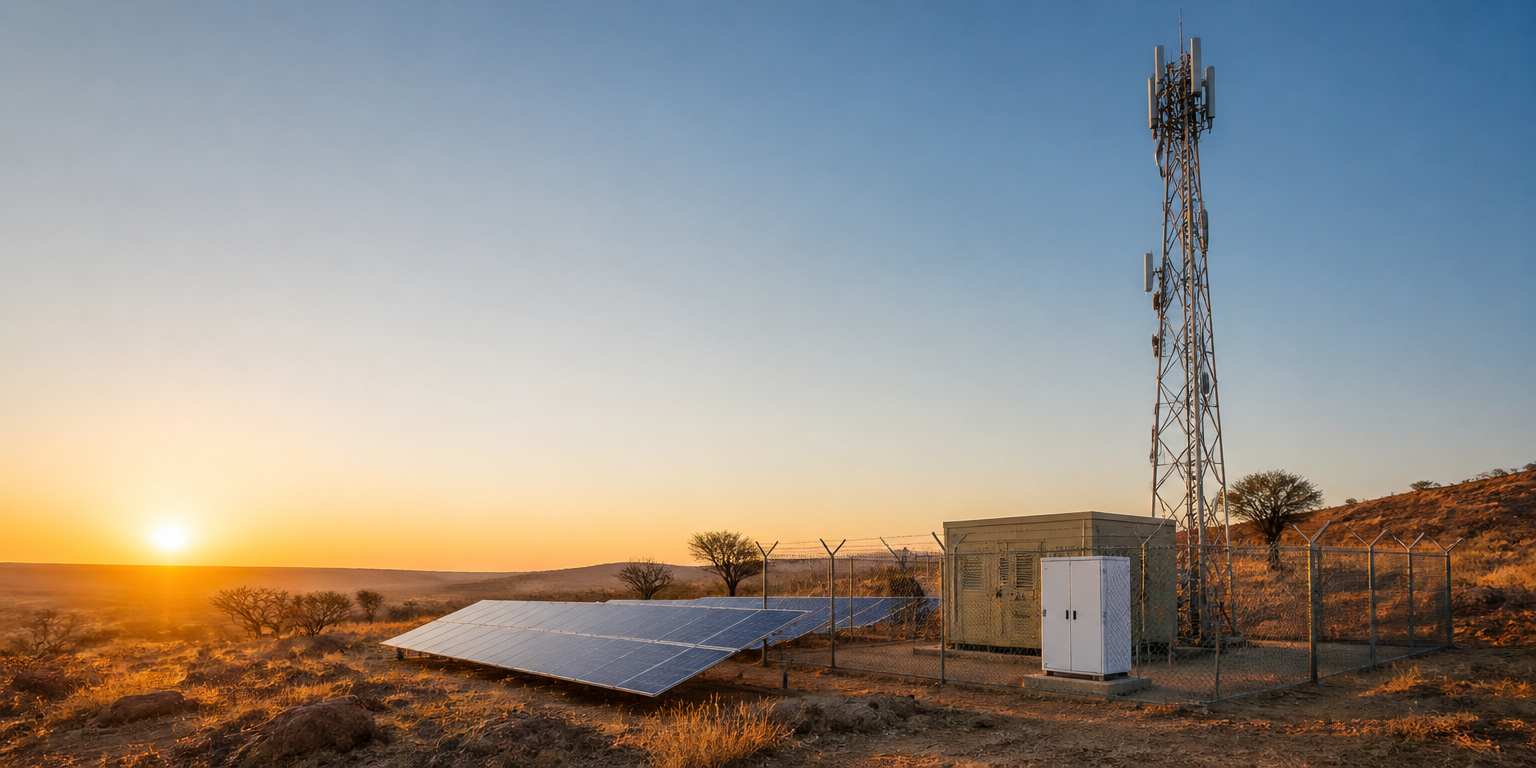


Remote telecom tower compound with hybrid solar and battery power at sunrise
EaaS Telecom · Energy as a Service

Stop buying rectifiers. Start buying uptime.

We fund, install, own and operate the entire energy system on your telecom sites. You pay for availability, not for equipment, and the capital stays on your balance sheet for the network itself.

Two ways to power a site

Own the equipment, or own the outcome

Both models keep the site on air. They differ in who carries the capital, who carries the fuel risk, and who gets the call at three in the morning.

The usual way

You buy the equipment

01
Rectifiers, batteries, generators and cooling are bought outright, and every one of them depreciates while the network they serve is what actually earns.
02
Purchasing, transport, on-site storage and reconciliation, across every site, with losses that are difficult to prove and harder to recover.
03
Battery strings degrade quietly and then fail together, landing as an unbudgeted capital event in the middle of a financial year.
04
When the energy chain fails, the outage, the SLA penalty and the subscriber complaints are all yours.
Energy as a Service

We deliver the energy

01
NETIS funds, owns and operates the full energy system. Your capital stays available for radio, spectrum and coverage.
02
Purchasing, refuelling, transport and reconciliation sit with us, along with the incentive to reduce consumption rather than pass it on.
03
Battery replacement, rectifier upgrades and cooling retrofits happen at our cost, when the monitoring says they are needed.
04
Uptime is measured, reported and penalised. If the energy chain fails, that is our exposure, not yours.
What we take over

The whole energy chain, from the meter to the load

Not a rental agreement on a generator. The complete site energy system, designed as one, owned by us and answerable to a single availability number.

Generation and hybridisation

Solar where the site justifies it, grid where it exists, generation held in reserve rather than run by default. The mix is set by the site, not by a standard design.

Storage

48V lithium or VRLA strings sized on measured outage duration and frequency, replaced by us before they take the site down rather than after.

Conversion and distribution

Rectifiers at 24 and 48 volts, converters, inverters, AC and DC distribution panels and controllers, all under one design authority.

Cooling

48V DC cooling for shelters, which removes the air conditioner as a single point of failure and takes its parasitic load off the bill with it.
How it stays up

The contract is only as good as the fleet behind it

An availability commitment without field capacity is a sentence in a document. Ours is backed by our own crews, our own fuel logistics and our own spare parts stock.

24/7 NOC dispatch

Monitoring and dispatch on every site under contract, with RMS platforms feeding the same dashboards your operations team already watches.

Fuel management

Purchasing, logistics, refuelling and reconciliation, with consumption tracked per site so a leak or a theft shows up as a curve, not as a surprise.

Field teams

End-to-end managed field teams, with preventive and corrective maintenance on both active and passive equipment.

Spare parts

Stock held against your installed base, because a response time commitment without parts on the shelf is arithmetic, not a plan.
Full scope of supply

Everything included in the tariff

Drawn from the telecom power and managed services lines of the NETIS catalogue. Under an EaaS contract you do not buy any of it — you pay for what it delivers.

Generation and hybridisation
Hybrid telecom power solutions combining grid, solar and generation. Telecom gensets to DC specification where a generator remains necessary. Energy optimization services across the site estate.
Conversion and distribution
Telecom rectifiers at 24 and 48 volts. Telecom converters and inverters. AC and DC distribution panels and controllers for telecom sites.
Storage and thermal
Telecom lithium batteries at 48 volts. Telecom VRLA batteries at 48 volts. 48V batteries for the telecom bay of energy. 48V DC cooling for telecom use and DC cooling solutions for telecom shelters.
Monitoring
Full RMS platforms for telecom sites. RMS integration. Smart controllers and sensors for fuel level, temperature and alarms. Integration with your existing telecom operations and maintenance dashboards.
Field operations
24/7 NOC dispatch and monitoring. End-to-end field teams management. Fuel management and logistics. Refuelling services covering transport and onsite delivery. Fuel saving devices.
Maintenance
Preventive and corrective maintenance on active and passive equipment. Spare parts management held against the installed base. Access control maintenance on the sites we operate.
Questions we are always asked

The contract, in plain terms

What exactly do we pay for?
Availability, expressed as a tariff per site per month, sometimes with an energy component. Not equipment, not fuel, not spare parts, not the crew that drives out at night. Those become our cost and our incentive to reduce.
Who owns the equipment?
NETIS and its financing partners own the assets for the duration of the contract. At the end of the term, ownership transfers to you in working order or the contract renews on refreshed equipment, whichever suits you.
What happens if a site goes down?
It counts against the contracted availability, and that has a financial consequence for us. Which is precisely why the monitoring, the spare parts stock and the field crews exist in the form they do.
Can you take over sites that already have equipment?
Frequently. It starts with an audit of what is installed and what condition it is in. Serviceable assets are absorbed into the contract; the rest is replaced at our cost as part of the transition.
Does this work on a small estate?
Most operators begin with one region or one difficult cluster, measure the availability and the cost per site over a full year, then extend. The model scales down more easily than a capital programme does.
How does it affect our reported emissions?
Hybridisation cuts generator running hours, and the RMS reports consumption and avoided CO2 continuously rather than annually. Where you report under a recognised framework, we align the output to it.
Next step

Send us the site list and twelve months of fuel data

Site locations, grid availability, current energy equipment and twelve months of fuel and outage records. That is enough to return a sized architecture and an indicative tariff per site.

Cart (0 items)

NETIS is a leader in the telecommunication and energy Industry, with over 17 years of experience in the design and development of high-performance network solutions.